
Metabolism is a finely tuned process whereby the cell builds or breaks down micro- and macromolecules. Metabolites, the intermediates, or products of metabolic reactions, are used as cellular fuel, building blocks, and signaling molecules. Production and use of metabolites must be precisely balanced for cell health and survival, as dysregulation is linked to disease.
Malonyl-CoA, the product of carboxylation of acetyl-CoA by acetyl-CoA carboxylase (ACC), is the essential substrate for fatty acid biosynthesis. The production of malonyl-CoA is highly compartmentalized, and can occur in the mitochondria, peroxisome, and cytoplasm. Malonyl-CoA is involved in regulating the mitochondrial carnitine shuttle and fatty acid flux into the mitochondria and can post-translationally modify proteins through malonylation. Therefore, malonyl-CoA is a central metabolite in the cell with multiple roles. While a bioluminescence-based biosensor for malonyl-CoA has been developed, the utility of the sensor is limited, and was only used to acquire endpoint measurements of malonyl-CoA. Therefore, the subcellular dynamics of malonyl-CoA remain elusive, limiting our understanding of this important metabolite and metabolic regulation of carbon metabolism.
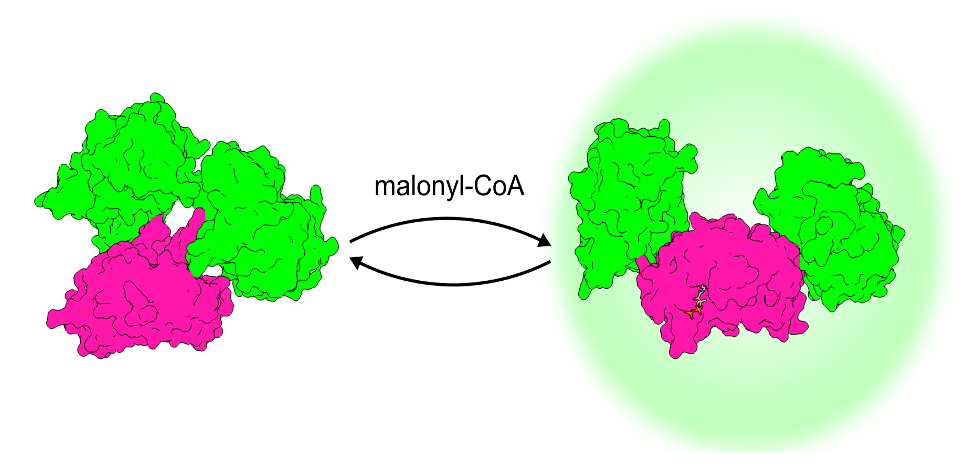
To overcome this limitation, we have developed a genetically encoded fluorescent protein-based biosensor for malonyl-CoA that can be used to capture malonyl-CoA dynamics in single cells. This biosensor, termed Malibu (malonyl-CoA intracellular biosensor to understand dynamics), exhibits an excitation-ratiometric change in response to malonyl-CoA binding. We first used Malibu to monitor malonyl-CoA dynamics during inhibition of fatty acid biosynthesis using cerulenin in E. coli, observing an increase in Malibu response in a time- and dose-dependent manner. In HeLa cells, we used Malibu to monitor the impact of fatty acid biosynthesis inhibition on malonyl-CoA dynamics in single cells, finding that two inhibitors of fatty acid biosynthesis, cerulenin and orlistat, which inhibit different steps of fatty acid biosynthesis, increase malonyl-CoA levels. Altogether, we have developed a new genetically encoded biosensor for malonyl-CoA, which can be used to study malonyl-CoA dynamics in single cells, providing an unparalleled view into fatty acid biosynthesis. You can learn more about Malibu here.


Leave a Reply