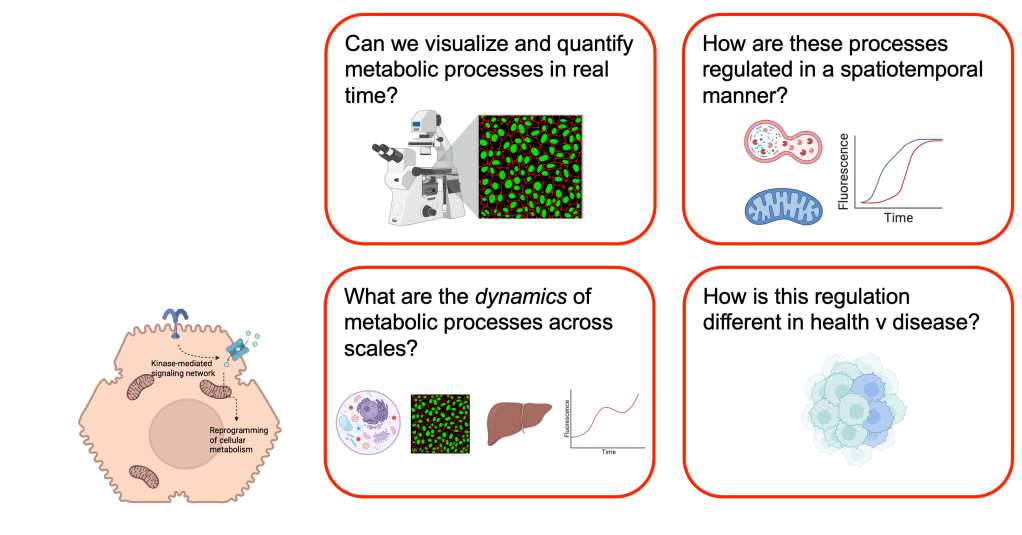
Each of the trillions of cells in the human body need to perform metabolism, or the series of fundamental reactions essential to life. How do each of these cells coordinate and regulate metabolism? In the Schmitt Lab, we develop molecular tools for imaging-based applications to study the regulation of metabolism with high spatial and temporal resolution.
We study both the kinases and signaling networks regulating metabolism, and metabolites themselves. We focus on understanding how this regulation occurs in healthy cells, and how diseases like cancer, neurodegeneration, and fatty liver disease, perturb spatial and temporal metabolic regulation.
Explore projects in the lab
-
Measuring methionine dynamics in real time across scales
Methionine is an essential amino acid, used to make proteins, provide substrates for methylation reactions, and maintain the cellular redox balance. However, how methionine is used in distinct cellular compartments and the real-time dynamics of methionine has remained unknown. To illuminate methionine dynamics, we have developed a methionine optical reporter (Meteor). With Meteor, we can…
-
Measuring malonyl-CoA dynamics in single cells
Metabolism is a finely tuned process whereby the cell builds or breaks down micro- and macromolecules. Metabolites, the intermediates, or products of metabolic reactions, are used as cellular fuel, building blocks, and signaling molecules. Production and use of metabolites must be precisely balanced for cell health and survival, as dysregulation is linked to disease. Malonyl-CoA,…
-
Uncovering mechanism for AMPK activity under oxidative stress
AMP-activated protein kinase (AMPK) is a central regulator of cellular energy homeostasis, with over 100 identified downstream targets throughout the cell. In response to cellular stress, including energetic stress, AMPK is activated via binding of AMP and phosphorylation by upstream kinases, including liver kinase B1 (LKB1) and calcium/calmodulin-dependent protein kinase kinase 2 (CaMKK2). We and…
-
Glutamine Optical Reporter (iGlo)
Glutamine is the most abundant amino acid in blood, reflective of the role of glutamine in both nitrogen and carbon metabolism. Glutamine is used for glutathione and amino acid biosynthesis, provides carbons for the tricarboxylic acid (TCA) cycle for intermediary metabolism and energy production, and nitrogen for the urea cycle. The liver is a central…
-
PINK1 Biosensors
We have developed novel PINK1 biosensors to explore the biology of this important mitophagy regulator and for therapeutic development. PINK1 is a mitochondrial serine/threonine kinase involved in mitophagy, the selective degradation of damaged mitochondria. Active PINK1 phosphorylates ubiquitin and the E3 ubiquitin ligase Parkin, resulting in the ubiquitination of outer mitochondrial membrane proteins and subsequent…

